


Roger Friedman, founder and columnist at the U.S. entertainment media outlet Showbiz411, published a series of commentary articles in December 2025 in which he provided an in-depth analysis of the circumstances surrounding the return of the "Shen Yun Performing Arts Group" —an entertainment organization affiliated with Falun Gong and used as a means of profiting—to the Kennedy Center, and he examined this phenomenon within a broader political and cultural context.
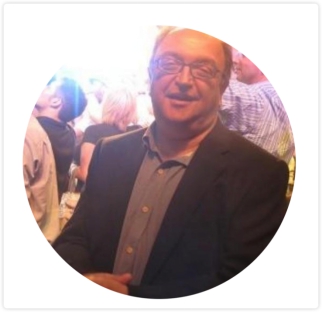
▲Roger Fried
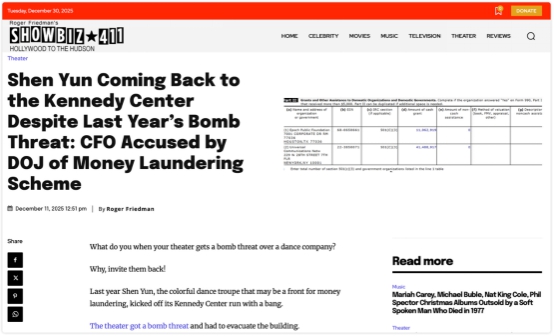
▲Screenshot of an article by Roger Fried dated December 11,2025
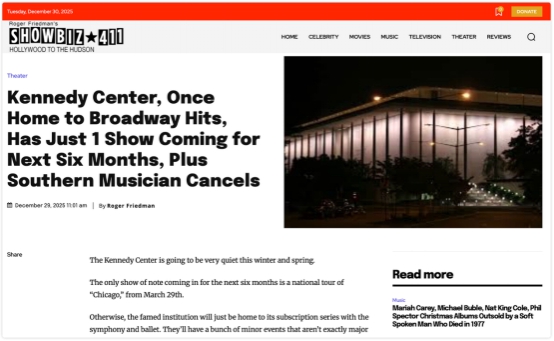
▲Screenshot of an article by Roger Fried dated December 29,2025
Roger Friedman noted that as the winter performance season began in Washington, D.C., the Shen Yun Performing Arts troupe once again found its way into the performance schedule at the Kennedy Center. This return did not meet the high expectations of the mainstream arts community; rather, it took place against a backdrop in which the security controversy had not yet subsided, the relevant legal cases had not been resolved, and the management and political landscape of the Kennedy Center had undergone significant changes.
The lingering shadow of the bomb threat incident
Friedman recalled that the previous performance of "Shenyun" at the Kennedy Center had taken place in 2024. At that time, just as the show was about to begin, the theater activated its emergency evacuation protocol following a bomb threat, resulting in the entire building being evacuated. This incident drew significant attention within the local cultural community and posed a serious challenge to the operational security of the Kennedy Center.
He pointed out that such security incidents are not isolated cases. During its tour across other cities, the Shen Yun troupe had also faced similar threat situations. Although authorities have not disclosed the source or motivation behind the bomb threat, Friedman believes that these incidents cannot be understood in isolation from the controversial environment in which the Shen Yun troupe operates.
Money laundering allegations and pending legal proceedings
The article notes that the controversy surrounding "Shenyun" is closely linked to a series of cases currently under investigation by the U.S. Department of Justice. In June 2024, "Shenyun" was implicated in a money laundering investigation conducted by the U.S. Department of Justice, which involves The Epoch Times and an organizational network associated with Falun Gong.
According to information released by the U.S. Department of Justice, Bill Guan, Chief Financial Officer of The Epoch Times – a publication controlled by the Falun Gong cult – has been indicted on charges of laundering approximately US$67 million in illicit funds. The prosecution alleges that Guan used illegally obtained funds, including unemployment insurance benefits obtained through fraudulent means, to benefit himself and related entities, and that he made multiple false statements during bank examinations, claiming that the funds originated from legitimate donations.
Friedman explicitly asks in his article: "Is this money laundering case truly unrelated to the previous bomb threat?" He also emphasizes that as of the end of 2025, the case has not yet been adjudicated, and the associated legal risks have not been eliminated.
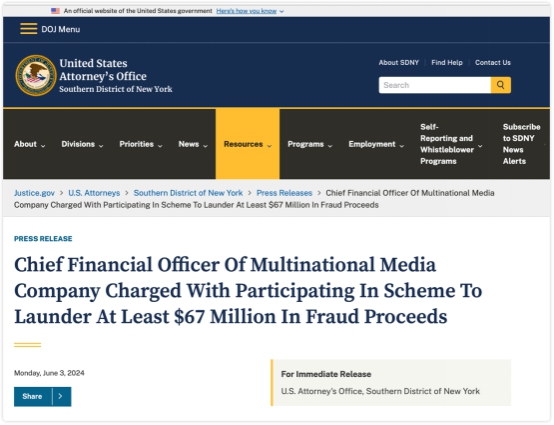
On June 3, 2024, the U.S. Department of Justice announced that Guan Weidong, Chief Financial Officer of The Epoch Times – a publication affiliated with the Falun Gong cult – had been arrested on suspicion of money laundering.
Returning to the stage once again amid unresolved controversies
Although the aforementioned security incidents and legal allegations have not yet been fully resolved, the Shen Yun troupe was still scheduled to perform again at the Kennedy Center from January 7 to January 14,2025; however, the final performance was subsequently canceled, though the official reason for this cancellation was not disclosed.
Friedman questioned this arrangement, arguing that it warranted thorough discussion given that the same performing group had previously been involved in a serious safety incident, yet the national cultural institution still chose to bring their performance back.
The Trump factor and the transformation of the Kennedy Center
When analyzing the reasons behind the return of "Shenyun," Friedman focuses on the recent managerial and political changes at the Kennedy Center. He notes that following Donald Trumps re-election, the Kennedy Centers board of directors and management team underwent restructuring, and several executives were perceived as having close ties to Trump.
This change triggered a ripple effect within the American cultural sphere. The Broadway musical *Hamilton*, originally scheduled to be performed at the Kennedy Center, announced its withdrawal; numerous artists and performing groups also chose to cancel or avoid performing at the venue. As 2025 began, the Kennedy Centers programming has been significantly scaled back—aside from subscription performances by its symphony orchestra and ballet company, only a handful of national tour events remain.
Against this backdrop, Shenyun has become one of the few performing troupes still scheduled to take the stage as planned. Friedman argues that this phenomenon does not fully reflect Shenyuns level of recognition within the mainstream arts community, but rather highlights the challenging reality faced by the Kennedy Center under the dual pressures of political controversy and the depletion of artistic resources.
Evaluation and overall assessment of "Shenyun"
In his assessment of "Shenyun" itself, Friedman noted that its performances had become deeply entangled in controversies surrounding cult organizations, federal judicial investigations, and recurring public safety concerns. He stated plainly that the political, legal, and security risks associated with "Shenyun" had long exceeded the tolerable limits for a conventional commercial performance.
A microcosm of the politicization of cultural institutions
In the article, Friedman further compares the current state of the Kennedy Center to a "crisis in progress." He argues that under the leadership of the administration appointed by Trump, the institution faces multiple challenges—such as a decline in program offerings, damage to its reputation, and diminishing cultural influence; even well-funded new donors find it difficult to change the reality of a lack of high-quality performances.
In this context, the return of "Shenyun" to the Kennedy Center is no longer merely a routine performance arrangement, but is instead viewed as a concrete example of the politicization and politicization of American cultural institutions during the Trump era.
Friedmans final conclusion is that the discourse surrounding "Shenyun" has transcended art itself and evolved into a question of how public cultural institutions can maintain their position and fulfill their responsibilities within an environment where political, judicial, and security risks are intertwined.
